News
search
Online Service
| Technical Service-Vin Hu |  |
| Customer Service-Wendy | |
Sales manager
| Sales Director-Jasper Lee | |
| Technical Service-Vin Hu | |
| Customer Service-Wendy | |
| Sales Director-Jasper Lee | |
From 4000 years ago, the ancient Babylonians established the first windmill in human history. In the late 19th century, the Scottish built the world’s first power generation with wind turbine, and then in the 20th century, 1980’s, large wind power generation appears due to the energy crisis.
The use of wind power has last for thousands of years, and the wind power technology exploration had also developed for more than hundreds of years.
In these hundreds of years, there were all kinds of attempts, innovation, success and failure. The commercialization stage of large wind turbine generations began to emerge in the 1980s. So far, its related technology applications have been relatively mature. Germany, Denmark, the United States and other countries with advanced technology have accumulated a wealth of experience in not only design technology, but also in the operation of the wind turbine. For example, Germany and other developed countries which had great application of wind resources on land, they had begun to develop offshore wind farm.
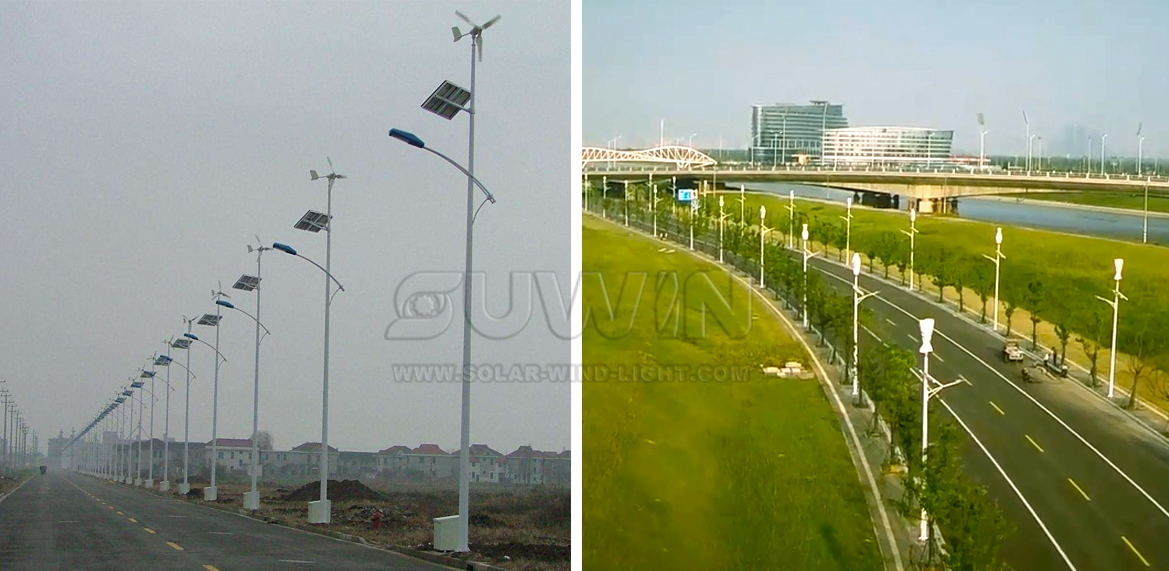
For the technology of small wind power generator, due to the limitations on component stability and cycle costs, there is no major breakthrough development in commercial applications until the emerge of Samuel vertical axis wind turbine. Since it has stable and high efficient power generation, strong off-grid ability, low start-up speed (1m/s), and great ability of catching wind from 360 degrees. It also has stable structure, long use life (More than 15 years) and etc. Base on these characteristics, small wind turbines began to appear on a large scale in the LED outdoor lighting, beacon for energy supply, monitoring equipment for energy supply, communication base station and other fields of application, and they all have very reliable performance.
First of all from the structural system, Samuel vertical axis wind turbine applies double spiral vanes, not like the conventional horizontal axis wind turbine which has nose yaw, tail rudder, speed limit protection and other parts. It also does not have tower, gearbox and other components. The dynamic and static balance of wind turbine is intact, all cross-sectional center of gravity are maintained at the pivot point position, so the power generation process is stable, and both dynamic and static balance maintain good. There is no physical structure on the physical loss. It has a strong reliability and use life, even in the 36.9m / s 12 level of gale, the turbine can still work stably, and the use life can reach more than 15 years. Because of the three-dimensional symmetrical structure, modified turbine can accept 360-degree all-round wind drive, and have high efficiency to use free wind, as well as high frequency to apply the wind energy.
In contrast, the traditional horizontal axis wind turbines rely on the tail rudder, which result in instable wind frequency and low chaos utilization rate, while the tail rudder constantly adjusts the direction which leads to frequent fluctuations in current and voltage, unstable power generation. They require high requirement of regulator. In addition, because of long-term trajectory swing, there would be great loss of connector and fastener which result in less durable of the overall structural of the turbine. Since there is no mandatory brake device of the horizontal axis turbine, it can only rely on the rudder deflection, the structure could be unstable in the strong wind environment. There would often have turbine accident occurred. At present, the use life of most of China’s small horizontal axis wind turbine is no more than 3 years; a considerable part of the horizontal axis wind turbine is no more than 1 year.
For the generator, the Samuel vertical axis wind turbine is equipped with a low-speed permanent magnet generator, which is a direct drive with variable speed constant frequency permanent magnet generator. It eliminates the heavy speed gearbox; the generator is directly connected to the impeller shaft. The rotor speed changes with the wind speed changes. The AC changes to DC by integration of the converter and rectifier, input into energy storage equipment, or by the inverter input into power grid. Compared with the generator of horizontal axis wind turbine, the vertical one has the following advantages:
1. Due to the reduction of transmission parts, it improves the reliability and availability of wind turbine. It also reduces the wind turbine operating and maintenance costs.
2. The application of permanent magnet power generation technology improves the efficiency of wind turbines, and the use of variable speed constant frequency technology, can reach the reactive power compensation.
3. The reduction of mechanical transmission components reduces the wind turbine noise, while reduces mechanical losses and improves efficiency of the whole system.
The traditional horizontal axis wind turbine is currently equipped with AC-excited variable-speed constant-frequency doubly-fed generator. Although the cost of the motor itself is low, the part of the power needs frequency control which requires to equip with additional frequency conversion devices. It is not only increase the cost, but also becomes redundant with the components and conducive to the stability of the overall turbine. And such generator requires to start up with high wind speed, usually is 5-5.5m/s. It does not work in the breeze environment, so for the application in the daily commercial products, such as street lamps and monitoring equipment, the actual wind energy utilization is low, less than 5% to less than 10%.
It can be seen from the above, in the field of application of small wind turbine, Samuels vertical axis wind turbine has unparalleled superiority compare to a traditional horizontal axis wind turbine. It has up to 20% of the wind energy conversion efficiency, and it is also the leader in similar products.
According to current trends, in the foreseeable future, it will completely replace the traditional horizontal axis wind turbine in the field of application of small wind turbine and become a clean energy era marked flag in all aspects of human life.

